How many times can a girl watch Gone with the Wind?
Sunday, April 11, 2010
Le Vent
How many times can a girl watch Gone with the Wind?
Sunday, April 4, 2010
La Romantisme

I was delighted to see whimsical romantic colors and silhouettes on the Paris runways for Fall instead of the traditional dark, severe garments. The John Galliano for Dior fall collection plays up pastels and equestrian femininity to create an atmosphere indicative of the Regency-era French upper class while Marc Jacobs for Louis Vuitton showcases the elegance and sensuality of fifties Rome. The two are very different collections but both are easily my favorites of the season for their decadence and irreverence. In an era where shock is the primary modus operandi, Galliano and Jacobs are able to bring a modern touch to classic styles and, in the process, create something truly beautiful. Check out the full collections on style.com.
Saturday, April 3, 2010
L’horloge
While at Barnard College, I had the privilege of sitting in on a First Year English class of which the students and teacher were very welcoming and inviting. The class was discussing T.S. Eliot’s The Waste Land and had a plethora of wonderful ideas about the poem, which, of course, caused us all to go off topic into a conversation about time.
The Waste Land is a commentary on the futility and hopelessness of a Post-World War I era. Time is cyclical here. The month of April is the transition from winter to spring when ice begins to melt and plants begin to grow. Eliot describes the difficulty to grow something beautiful and worthwhile out of barren soil in the first days of spring. The people play a game of chess amidst this phenomenon with a proprietor telling them to “HURRY PLEASE IT’S TIME” like a clock in his precision.
Humans use time as a crutch because otherwise we would be lost. We would wake during the day and sleep during the night with no knowledge of how far we are from birth and how close we are to death. Furthermore, time fosters efficiency. The more we advance and compartmentalize our lives, the more we need to organize our time. Losing time is scary. There is a mental clock reminding us that we have 5 minutes to finish a project and fifty years until we die and slowly, slowly, quickly, quickly time falls away and we creep closer to the end. As the professor teaching the class said, “We don’t want to waste time, but we don’t want to become a slave to it either.”
As a student brought up, when Edison invented the light bulb, he thought he would be eradicating sleep from society, therefore optimizing efficiency. We were taught that “time and tide wait for no man” and to waste time doing anything that doesn’t return on its investment is failure. We were taught that success is to, in the words of Mad Men’s Pete Campbell, “own a house, a car, a television, the American Dream!” A postcard perfect life in a neatly organized suburb is success. We don’t spend time relaxing or processing. That would be wasting time when we could be buying more, earning more, proving ourselves more worthy to others. Even our entertainments are optimized for efficiency from the television to the iPod to the iPhone, which I suppose is all in one.
Would Eliot see us as a cultural wasteland? Would it be because, as he portrayed in The Hollow Men, we don’t stop and think and feel? Is it worth it to ration our time “wisely”? Is there a purpose to time when it becomes repetitive and monotonous? Perhaps The Waste Land applies to us now more than ever as we try to make sense of a new society. Has time become a prison for which there is no key? I think our most human and pervasive fear is the feeling that we don’t have enough time, and I suppose the reason we don’t have enough time is because we don’t want to waste time. Eliot “show[ed] you fear in a handful of dust” so look it in the eyes and see if you recognize it.
Friday, April 2, 2010
Vous Nous Manquez
Thursday, April 1, 2010
Les Sans-Abri
A personal essay assignment inspired some reflection this past spring break as I decided my role as a traveler would make for an interesting narrative and expression. Understandably, on my way to the East Coast to visit colleges, I packed my copy of Jack Kerouac’s On the Road to read on the airplane. It is an intriguing autobiographical treatise on the Beat Generation and an account of the epiphanies brought on by travel. However, despite Kerouac’s exuberance about America’s unique landscapes while crossing from the East to the West, there is a sense of coming of age and learning hard lessons. Sal Paradise’s hero, Dean Moriarty, becomes nothing more than a directionless, though somewhat endearing wanderer and, for a while, Paradise becomes disenchanted with the myth and legend of America as a promised land. Yet at the end, after reflection on life and humanity, Paradise admits that Moriarty is his figurehead of American life.
I, personally, love Kerouac’s works, all memoirs and documentations of his life and travel, but On the Road is by far my favorite. More than its spawning of a culture of coffee shop poetry and flannel button-downs, the novel raises questions about home and frontiers. Are they truly a cold people who move from place to place looking neither forward nor backward, or are they simply enviably free? Kerouac does not seem to answer this question through Dean Moriarty. Similarly, Truman Capote, who famously quipped “That’s not writing; that’s typing” about Kerouac’s novel, creates a flighty heroine who is a citizen of everywhere and nowhere in Breakfast at Tiffany’s. Holly Golightly is the epitome of the lively yet sorrowful girl who has no sense of belonging yet yearns for a place that feels like home.
This sense of rootlessness pervades our society today. A myth has been created about the beautiful wanderer, the enigmatic, restless youth who never seems to stay too long in one place. We see these delightfully lost souls in 500 Days of Summer and Looking for Alaska and Up in the Air. We move quickly because it’s so much easier to leave and create something new someplace else than to get attached to something that’s sort of beautiful and have to mourn for it when it all falls apart. Elsewhere holds the promise of something better and, in that way, is always attractive. Who wants to spend forever in one place? I want to move, I want to live, I want to learn. Home isn’t a place, it’s a feeling, and you won’t find it sitting in one place for the rest of your life. So go, take yourself where life leads you. You probably won’t be disappointed.
À bientôt
Friday, June 12, 2009
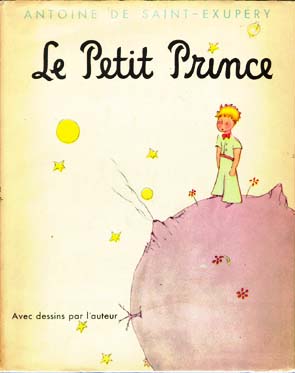
Le Petit Prince
The novella begins with the Prince meeting the narrator in the middle of the Sahara. He asks the narrator to draw him a sheep, and, after many failed attempts, the narrator draws a box which, he explains, houses the sheep. The Prince is finally satisfied. Over the next eight days, the Little Prince entertains the narrator with tales of his adventures.
Thursday, June 11, 2009
Je pense à toi ...
Giambattista Valli, why do you torment me? What have I ever done to you besides worship the ground your shoes tread upon?
"Give a girl the right shoes, and she can conquer the world." - Marilyn Monroe
À Bientôt,